Finally, an easy way to make the GME zeolite...
... fault free and with less Aluminum!
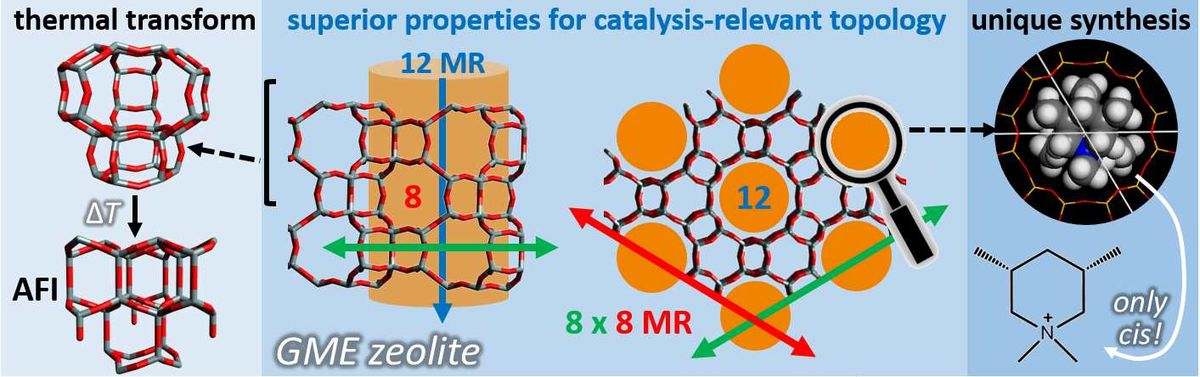
GME is a very interesting zeolite topology
It is a 2D 8MR intersected by a 12MR large pore channel.
It has potential for reactions where shape selectivity and molecular traffic control are important, e.g. hexane dehydrocyclization.
It is however very hard to make, and almost always, the zeolite is not porous, due to faulting, causing the main channel to be blocked.
Not anymore!
The Dusselier and Davis labs have found a new route to a non-faulted GME, the new material is know as CIT-9.
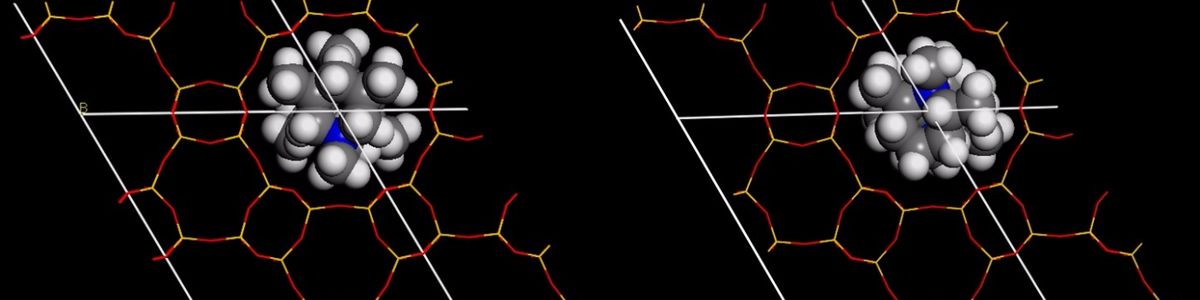
Above: The unexpected tight and beautiful fit
Two cis-isomers forms of the OSDA (organic structure directing agent) are seen on the left, stabilizing the 12MR pore.
This fit is very tight and the likely driving force behind the synthesis of CIT-9.
On the right, the trans-isomers of the same OSDA are seen; these do not fit well at all. (space between channel and organic).
In fact, only with cis-OSDA in high concentrations, one has access to CIT-9!
The figure in the banner above...
.... shows why high concentrations of OSDA are needed: with more water (or higher dilution) in the synthesis mixture, the AEI zeolite is formed, instead of GME.
AEI is a small pore zeolite with 8MR channels and a large cage. The cis-OSDA is known to direct to the synthesis of AEI in these conditions.
What was not known, is that in highly concentrated low water systems, GME starts to be the dominant product!
Read all about it here:
CIT-9: A Fault-Free Gmelinite Zeolite
This can be considered the first paper published since the start of the autonomous research group.
It was included in the online issue on October 11, 2017
synthetic, fault-free gmelinite (GME) zeolite is prepared using a specific organic structure-directing agent (OSDA), cis-3,5-dimethylpiperidinium. The cis-isomers align in the main 12-membered ring (MR) channel of GME. Trans-isomer OSDA leads to the small-pore zeolite SSZ-39 with the OSDA in its cages. Data from N2-physisorption and rotation electron diffraction provide evidence for the openness of the 12 MR channel in the GME 12×8×8 pore architecture and the absence of stacking faults, respectively. CIT-9 is hydrothermally stable when K+-exchanged, while in the absence of exchange, the material transforms into an aluminous AFI-zeolite. The process of this phase-change was followed by in situ variable temperature powder X-ray diffraction. CIT-9 has the highest Si/Al ratio reported for GME, and along with its good porosity, opens the possibility of using GME in a variety of applications including catalysis.
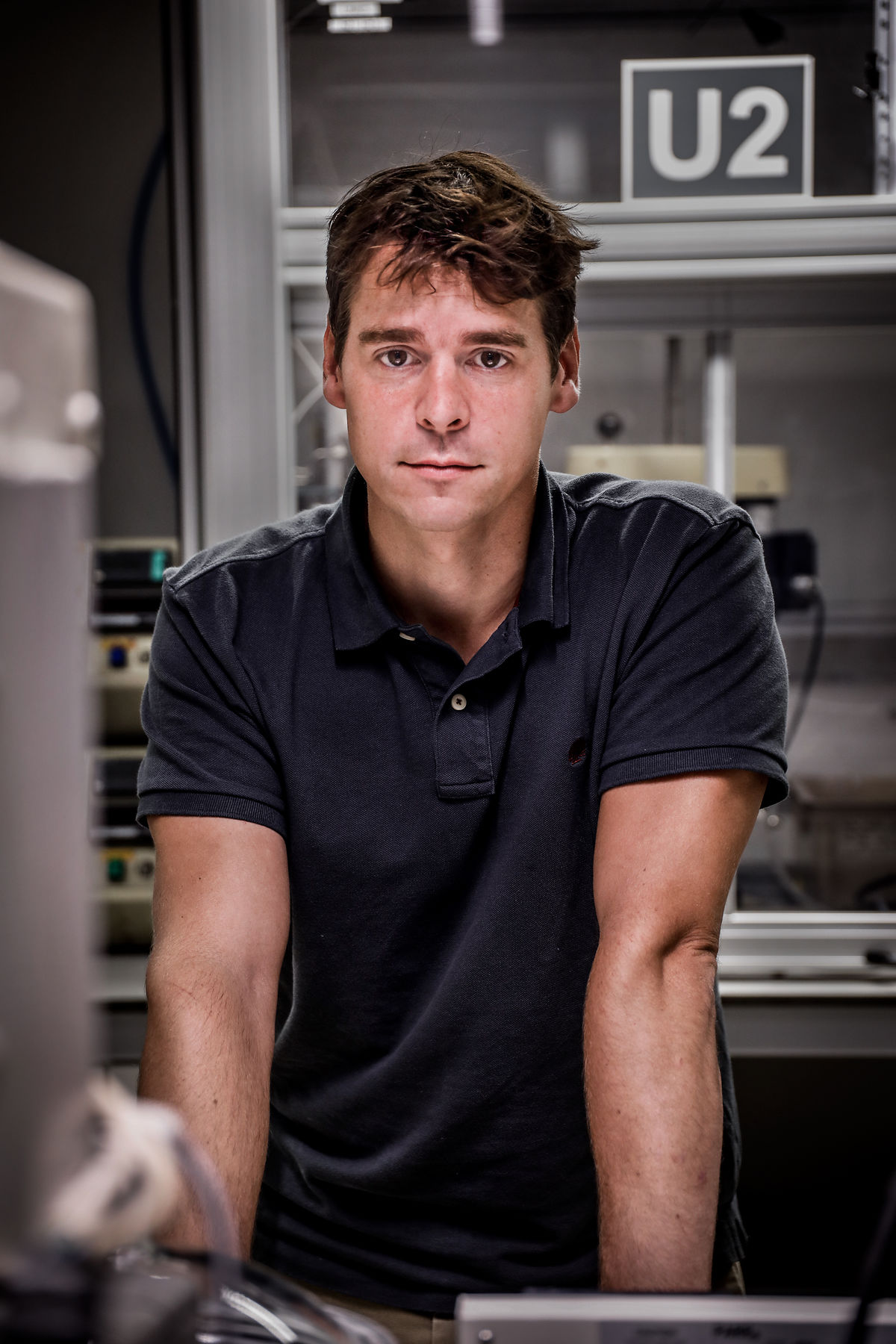
Michiel Dusselier
Professor